
As I wrap up another year of working with small- and mid-sized B2B businesses, I’ve noticed common questions in client meetings, LinkedIn messages, and, yes, across my 2025 blog posts.
This year, one thing became very clear: successful businesses are approaching marketing as a strategic function, not a collection of tactics. And the ones seeing the strongest growth have embraced a few core principles: brand discipline, thoughtful content, AI-enabled visibility, and the internal marketing policies needed to protect it all.
To make these insights easy to reference, I’ve gathered the most important takeaways from my 2025 blogs in a simple FAQ format. Consider this your guide to what matters most heading into 2026.
Why should I treat my brand like a business asset, not just a logo or a tagline?
Because it is an asset.
Your brand influences three critical business outcomes:
- Revenue predictability — A strong brand reduces friction along the buyer journey and shortens sales cycles.
- Value creation — Brand equity directly impacts how the business is perceived in future investment, partnership, or acquisition conversations.
- Market differentiation — SMBs often assume they’re “different,” but without consistent brand execution, that difference never reaches the market.
In 2025, I wrote extensively about how a brand drives business value. And the takeaway is simple: Your brand is working for you all the time—even when you’re not in the room. Treat it like the strategic asset it is.
- What has changed about SEO—and how do I show up in an AI-driven search world?
AI has redefined search, and more importantly, where your customers get answers.
In a world of zero-click queries and generative AI summaries, B2B buyers aren’t always clicking through to websites. They’re getting answers directly from the search experience.
For SMBs, this means:
- Your content must be authoritative, structured, and trustworthy so AI tools can confidently pull from it.
- You need clear positioning, so AI models understand who you serve and what you’re known for.
- Your digital footprint (website, LinkedIn, reviews, profiles) must be consistent, because AI systems cross-verify your brand.
The new goal isn’t just ranking—you’re writing for AI models that summarize, extract, and present your content in response to natural language queries.
What internal marketing policies should every B2B business have?
If 2025 taught us anything, it’s that SMBs need stronger marketing governance. Not bureaucracy—but clarity.
The most successful companies I work with have policies around:
- Brand and messaging usage
- Content creation and approval
- Crisis communication
- AI usage and data accuracy
- Email marketing and list management
- Social media
- Website updates and maintenance
- Vendor relationships
- Intellectual property protection
- Metrics and reporting cadence
These policies save time, reduce risk, and create consistency, especially as businesses grow and more people touch the brand.
- Why does intellectual property matter to marketing?
Because brand, content, and creative assets are IP, protecting them protects your market position.
In one of my most foundational 2025 blogs, I explained how IP supports marketing by:
- Safeguarding brand identity
- Preventing misuse of content
- Protecting designs, messaging, and creative assets
- Clarifying ownership with contractors and agencies
- Increasing business valuation
For SMBs, IP is often overlooked until there’s a problem. But it’s far more effective and cost-efficient to think about protection before you scale your marketing.
- What marketing myths held SMBs back this year?
A few stood out in 2025:
“We’re different.”
Most businesses believe this, but clients only know what you consistently demonstrate.
“We don’t need brand guidelines; everyone knows what to do.”
Until they don’t—and inconsistencies show up in the market.
“SEO is dead.”
It’s not dead. It’s redistributed across platforms, and AI is now part of the equation.
“We don’t have time for content.”
Content is your digital salesforce. Without it, you lose visibility and credibility.
Myths aren’t harmless. They often create blind spots. And blind spots show up as missed opportunities.
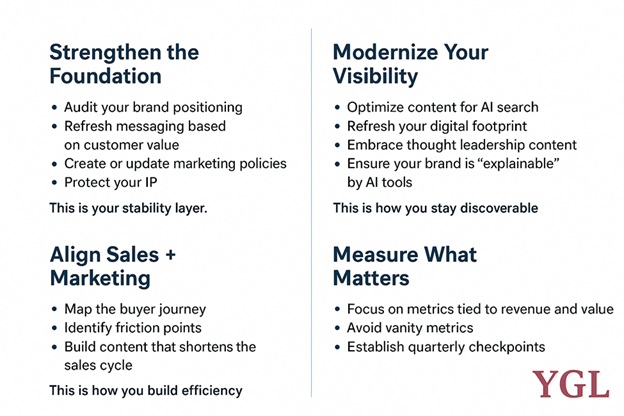
What should SMBs prioritize in 2026? (Your Strategic Roadmap)
Here’s my unified strategic framework that connects all my 2025 content:
What’s the one question SMBs should ask themselves going into 2026?
“Is our marketing building long-term business value, or are we just chasing tactics?”
Those companies that approach marketing with:
- Clarity
- Consistency
- Discipline
- And a clear sense of what makes them credible will be rewarded in 2026 and beyond.
Final Thought
2025 brought significant shifts in how SMB’s should think about marketing, brand, AI, and organizational readiness. Strong businesses make strategic decisions. And strategic marketing supports every part of the business—revenue, operations, brand, and long-term value.
If you’re ready to elevate your marketing strategy and drive meaningful growth in the new year, let’s talk. At YGL Marketing, we help SMBs unlock the power of marketing as a true business driver. Contact us today to start the conversation. Let’s make 2026 your strongest year yet.
Yvonne Levine is the president of YGL Enterprises, Inc. As a strategic marketing consultant, she partners with B2B companies to develop data-driven marketing strategies, refine brand messaging, and deliver measurable results. Connect with Yvonne on LinkedIn.
 Yvonne Levine is the president of YGL Enterprises, Inc. As a strategic marketing consultant, she partners with B2B companies to develop data-driven marketing strategies, refine brand messaging, and deliver measurable results. Connect with Yvonne on LinkedIn.